
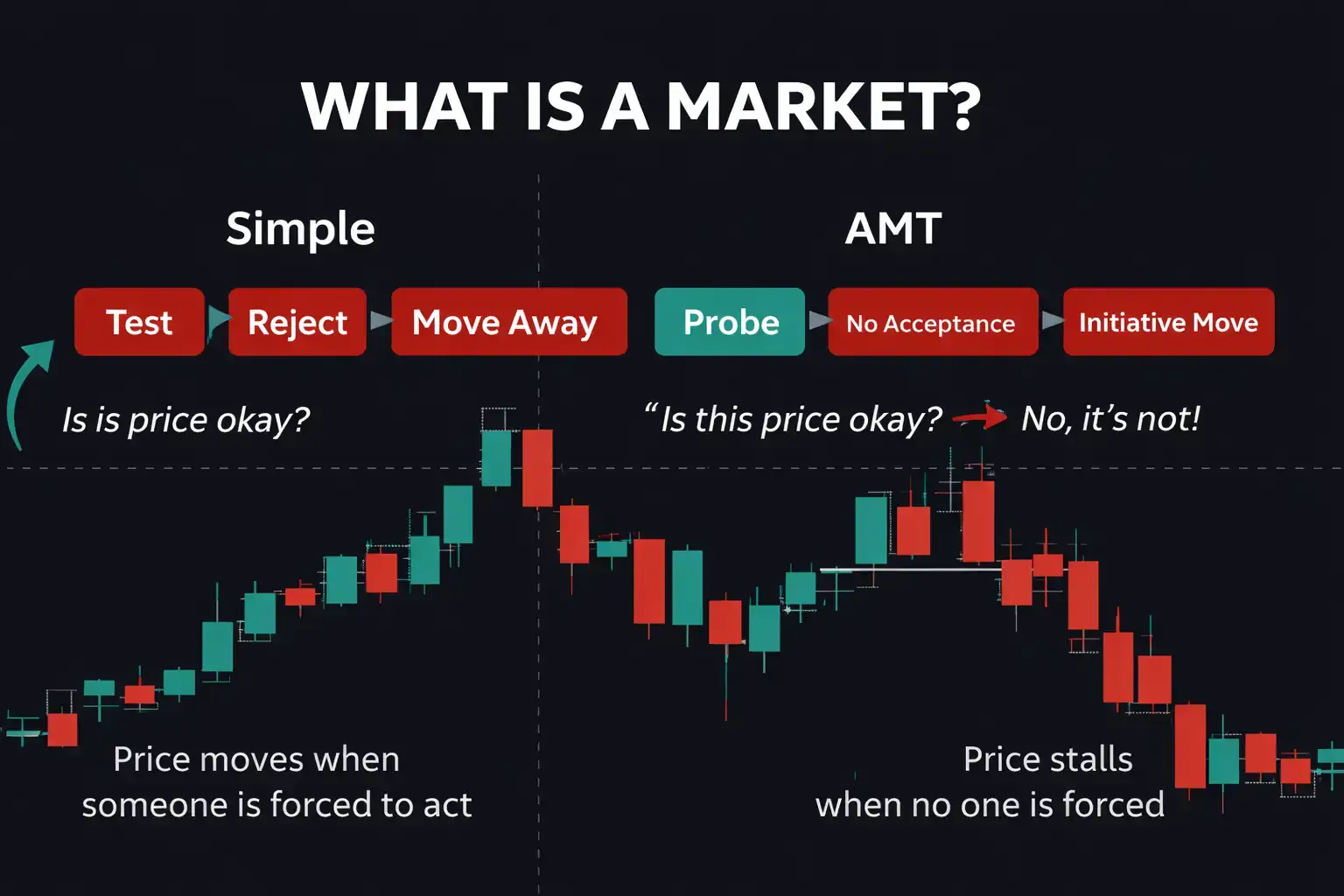
What Is a Market?
Understanding Why Price Moves (AMT – Part 1)
Introduction
This is not a trading strategy.
There are no predictions here.
No setups. No signals.
The goal is simple:
To understand why price moves… and why it sometimes does not.
We will look at the market as it actually behaves — directly from the chart.
To keep things clear, we use two layers in parallel:
- Layer 1 — Simple: what we see
- Layer 2 — AMT: what it means
Clarity comes first. Precision comes second.
What is a market?
🔹 Layer 1 — Simple
A market is where people trade.
- Someone wants to buy
- Someone wants to sell
- They agree on a price
- A trade happens
This keeps repeating.
And that is what creates movement on your chart.
You will always see one of three things:
- Price moving up
- Price moving down
- Price moving sideways
🔹 Layer 2 — AMT
A market is an auction process.
The purpose of this process is:
Price discovery
The market is constantly trying to find a price where buyers and sellers agree.
The core principle
Everything we do builds on this:
Price moves when someone is forced to act
Price stalls when no one is forced
This is not theory.
You can see it on every chart.
The movement loop
The market is always doing the same thing:
- Move price
- Observe what happens
- Either stay… or move away
🔹 Layer 1 — Simple
- Test a price
- If price holds → stay
- If price fails → move away
🔹 Layer 2 — AMT
- Probe
- If accepted → balance
- If rejected → initiative move / imbalance
Agreement and disagreement
Agreement
Agreement means both sides are comfortable trading at that price.
You will see:
- Small candles
- Back-and-forth movement
- Slower behavior
👉 AMT: Balance / Value
Disagreement
Disagreement means one side becomes aggressive.
You will see:
- Strong movement
- Little hesitation
- Price leaving the area quickly
👉 AMT: Imbalance / Initiative activity
Why price moves up
This is where many misunderstand the market.
Price does not move up because buyers are “right”.
🔹 Layer 1 — Simple
Price moves up because:
- Buyers are pushing
- No one is stopping them
🔹 Layer 2 — AMT
Price moves higher because:
There are not enough sellers at that level
The market is not trending for the sake of trending.
It is simply moving until it finds opposition.
Why price stops and reverses
At some point, price reaches a level where things change.
🔹 Layer 1 — Simple
- Price goes up
- It tests higher
- It cannot continue
- It moves down
🔹 Layer 2 — AMT
- Probe higher
- No acceptance
- Initiative sellers enter
Who “rejected” the price?
It may feel like:
“Someone decided this price is too high”
But that is not how it works.
What actually happens
Two things occur at the same time:
- Buyers stop being willing
- Sellers become aggressive
If nothing happens, price does not move.
So the key is:
The side that acts aggressively is the one moving price
In a rejection from higher prices:
👉 Sellers are the ones taking control.
What creates “forced” selling?
Not all selling moves price.
Only urgent selling does.
Here are common real situations:
- Traders exiting bad positions
- New sellers entering aggressively
- Too many buyers already in the market (imbalance)
- Stop losses being triggered
All of these create the same thing:
Non-optional action
There is no third actor
This is an important clarification.
It can feel like:
“The market is searching for sellers”
But there is no hidden force.
Reality
There are only:
- Buyers
- Sellers
And each can be:
- Passive (waiting)
- Aggressive (acting now)
What actually moves price
Price moves when:
Aggressive orders overwhelm the other side
That’s it.
No third participant.
No “market deciding”.
A simple example
Let’s connect everything.
🔹 Layer 1 — Simple
- Price moves up
- It tests higher
- A rejection candle forms
- Price moves down
🔹 Layer 2 — AMT
- Auction higher
- Probe
- No acceptance
- Initiative selling
What this means
- Buyers pushed price up
- Sellers were not strong yet
- At higher prices, sellers became active
- Buyers stopped supporting
- Price moved down
One clean mental model
Instead of thinking:
“The market is deciding”
Think:
Buyers push until sellers stop them
And:
Sellers push until buyers stop them
Final takeaway
The market is an auction where price moves until it finds opposition — and only moves when someone is forced to act.